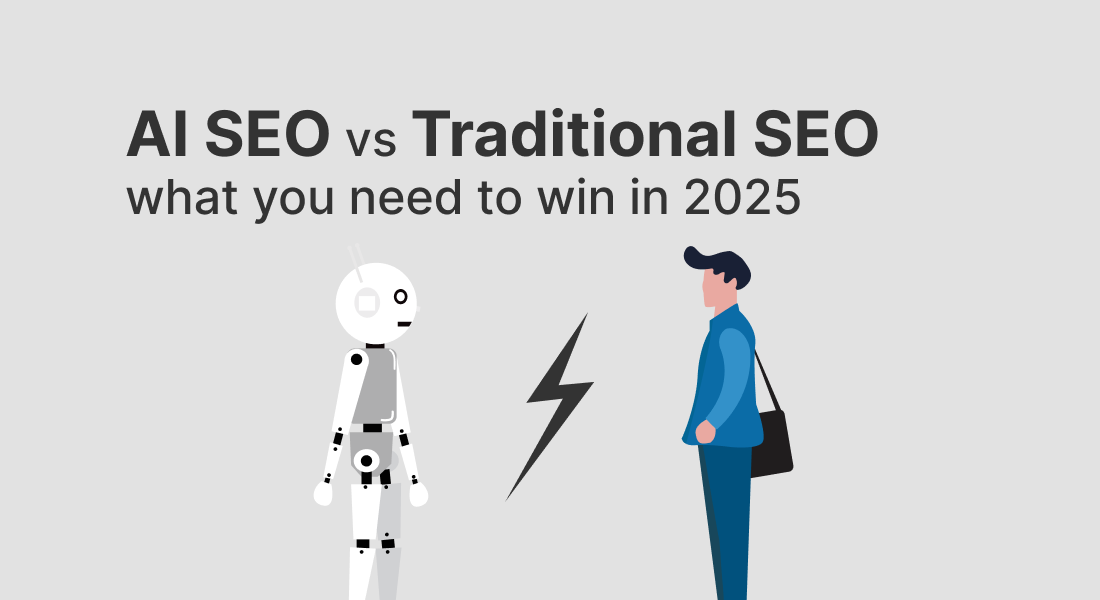
AI SEO vs Traditional SEO: What You Need to Win in 2025
In 2025, search engine optimization is no longer about just inserting keywords and building backlinks. With AI-powered search engines, generative search experiences (GSE), and advanced ranking algorithms reshaping how users find information, SEO has evolved into a smarter, faster, and more predictive discipline. At Kantha Digital, we specialize in helping businesses master this shift by blending AI SEO vs Traditional SEO strategies to achieve better rankings, visibility, and ROI.
If you want your business to thrive in this new AI-driven era, you need to understand how AI SEO impacts keyword optimization, content creation, metadata, and search performance while balancing it with tried-and-true traditional SEO strategies.
In this manual, we’ll dive into Generative Engine Optimisation (GEO), AI’s role in SEO, tools to grasp this hybrid technique, and how to measure outcomes efficiently.
Table of Contents
- Understanding Generative Engine Optimisation (GEO)
- How AI Affects Keyword Optimisation, Metadata, and Headings
- Balancing Human-Written Insights With AI Tools
- Ethical Practices to Avoid AI Spam Penalties
- Tools That Fuse AI-Powered Analysis With Traditional SEO
- Measuring Performance via Rankings, Traffic, and Snippet Presence
- FAQs
- Conclusion
1. Understanding Generative Engine Optimisation (GEO)
Generative Engine Optimisation (GEO) is the next big step in SEO. Search engines like Google are shifting toward AI-generated answers in Search Generative Experience (SGE), where users receive summarized AI-driven responses before clicking on links.
What is GEO?
- GEO focuses on optimizing content for AI search engines, ensuring your website appears in these generated answers.
- Unlike traditional SEO, where ranking pages in SERPs is the goal, GEO is about making your content relevant enough to be sourced by AI and featured directly in AI-driven snippets.
Key GEO strategies:
- Topic Depth: Cover subjects comprehensively with expert-level detail.
- Semantic Keywords: Use NLP-driven keyword tools to align with AI’s contextual search.
- Structured Data: Implement schema markup for entities and relationships.
- E-E-A-T Signals: Highlight experience, expertise, authority, and trustworthiness in content.
2. How AI Affects Keyword Optimisation, Metadata, and Headings
AI SEO changes how we approach keywords and on-page optimization. Search engines use AI-driven natural language models to understand search intent rather than just keyword density.
AI Keyword Optimization:
- Focus on long-tail conversational phrases (e.g., “best AI SEO tools for 2025” vs. “SEO tools”).
- Use predictive keyword tools like Google’s AI features or SEMrush AI Keyword Magic to target upcoming trends.
Metadata and Headings:
- Write AI-friendly meta titles and descriptions that match intent.
- Use semantic headings (H2/H3) aligned with AI clustering.
Example:
Instead of “SEO Tools,” use “AI SEO Tools That Boost Rankings in 2025” in headers for contextual relevance.
3. Balancing Human-Written Insights With AI Tools
While AI tools help generate drafts and analyze data, human creativity remains critical. Google’s Helpful Content Update emphasizes authentic, experience-driven content.
How to balance:
- AI’s Role: Generate keyword clusters, draft outlines, and analyze SERPs.
- Human Role: Add personal experience, storytelling, and unique value propositions.
📌 AI speeds up workflows, but human input ensures relevance, trustworthiness, and compliance with E-E-A-T.
💡 Related: How to Write Blogs That Rank #1 on Google
4. Ethical Practices to Avoid AI Spam Penalties
Google is cracking down on AI spam content that adds no value. Overusing AI-generated copy without review can lead to ranking drops or deindexing.
Best Practices:
- Avoid AI Overload: Do not publish unedited AI outputs.
- Focus on Value: Ensure content solves real user problems.
- Diversify Content Types: Use infographics, videos, and case studies alongside text.
- Monitor Google Updates: Stay informed about AI detection and anti-spam updates.
5. Tools That Fuse AI-Powered Analysis With Traditional SEO
The smartest marketers use hybrid SEO tools that merge AI-driven insights with traditional SEO checks.
Top Tools for AI + SEO:
- Surfer SEO – AI-driven content analysis with keyword density suggestions.
- SEMrush AI – Combines intent analysis with backlink strategies.
- Clearscope – NLP-focused content optimization for semantic search.
- Google Search Console AI Insights – Predicts keyword trends and traffic sources.
💡 Related: Keyword Research to Get Higher Rank in SERP
6. Measuring Performance via Rankings, Traffic, and Snippet Presence
In AI SEO, success isn’t just about ranking #1—it’s also about featured snippets and AI-sourced mentions.
Metrics to Track:
- Organic Rankings: Measure keyword shifts via SEMrush or Ahrefs.
- AI Snippet Visibility: Track inclusion in AI-generated summaries.
- Traffic and Engagement: Monitor bounce rates and time-on-page.
- Conversion Rates: SEO traffic should tie directly to sales or leads.
📌 Tip: Use tools like Ahrefs Rank Tracker and Google Analytics 4 to monitor results.
FAQs: AI SEO vs Traditional SEO
Q1. What is AI SEO, and how is it different from traditional SEO?
AI SEO focuses on optimizing for AI-driven search engines and generative experiences, whereas traditional SEO emphasizes SERP rankings and backlinks.
Q2. Is AI SEO replacing traditional SEO?
No. AI SEO complements traditional SEO. You need both to succeed in 2025.
Q3. How do I optimize for AI-driven search engines?
Focus on semantic keywords, structured data, and GEO-friendly content.
Q4. Will AI-generated content rank well?
Yes, if edited and enhanced with human expertise and real-world value.
Q5. What tools should I use for AI SEO?
Tools like Surfer SEO, Clearscope, and SEMrush AI are excellent for blending AI analysis with classic SEO.
Conclusion: AI SEO vs Traditional SEO—The Winning Formula in 2025
In 2025, AI SEO vs Traditional SEO is no longer about choosing sides—it’s about integrating AI-powered insights with proven SEO tactics.
The winners will be those who:
- Leverage AI tools for predictive insights and automation
- Maintain human-led creativity and expertise
- Continuously adapt to Google’s evolving AI-driven search environment
By combining AI SEO strategies and traditional SEO best practices, you can dominate organic search, earn AI snippet visibility, and stay ahead of competitors.
Ready to optimize smarter? Explore our On-Page SEO Service Agency and Link Building Service Agency to implement cutting-edge SEO strategies that drive results.

We help brands grow to their fullest potential. Don’t miss out on your chance to stay up to date with latest trends.